
Think You Don’t Have a Contract Because You Never Signed One? Think Again.
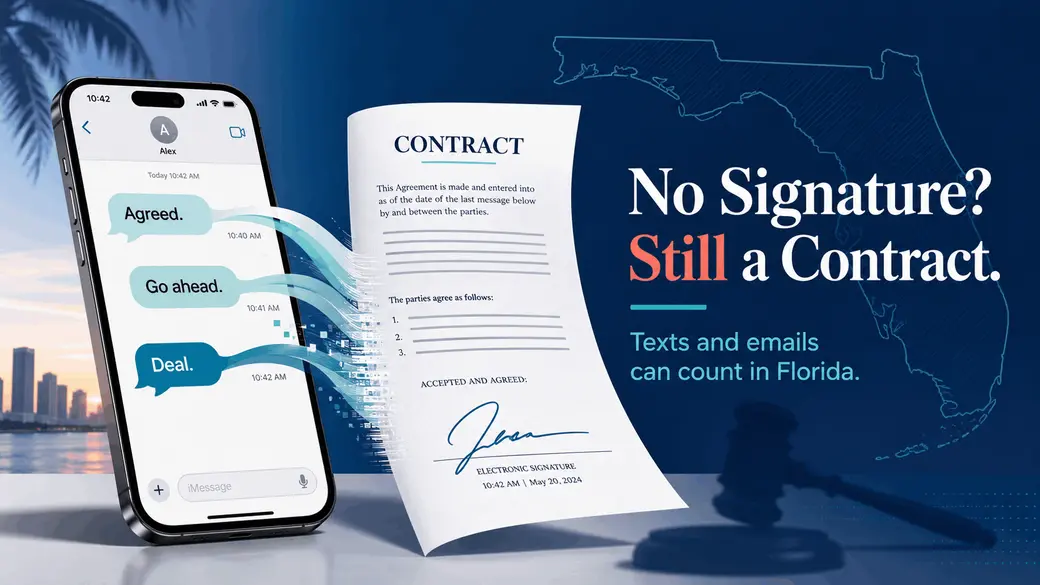
Think You Don’t Have a Contract Because You Never Signed One? Think Again. ⚖️
In Florida, “I never signed anything” may not mean what you think it means.
“But I never signed a contract.”
Those may be five of the most dangerously comforting words in business.
Most of us picture a contract the same way: several pages of legal language, initials at the bottom, signatures on the last page, perhaps a witness or notary—and today, probably a DocuSign envelope.
No signature?
No contract.
Not necessarily.
Under Florida law, the absence of a traditional signed document does not automatically mean there was no enforceable agreement.
And in a world where we negotiate business through text messages, emails and smartphones, that distinction matters more than ever.
Because the contract you eventually fight about may not be sitting in a folder labeled CONTRACTS.
📱 It may be sitting in your text messages.
First Things First: Contracts Don't Always Require a Formal Signature
A contract is fundamentally an agreement between parties—not necessarily a particular piece of paper.
Florida law recognizes oral contracts in circumstances where the law does not specifically require the agreement to be in writing.
Of course, that doesn't mean every conversation creates a contract.
Courts still look for the fundamental elements of contract formation: sufficiently definite terms, consideration and objective evidence that the parties actually reached an agreement.
But consider an ordinary business conversation:
“I'll pay you $10,000 if you bring me this deal.”
“Agreed.”
The person performs the work.
The deal closes.
Then it's time to pay.
Suddenly:
“Where's the signed contract?”
That's an important question.
It just isn't necessarily the end of the inquiry.
Welcome to Contract Law in the Smartphone Era 📱
Here's where things get particularly interesting.
Florida has adopted the Uniform Electronic Transaction Act, found at Florida Statute §668.50.
The statute provides that a record or signature cannot be denied legal effect or enforceability solely because it is electronic.
It goes further.
A contract cannot be denied legal effect or enforceability solely because an electronic record was used in forming it.
And, where the statute applies, if another law requires a record to be “in writing,” an electronic record can satisfy that requirement. If the law requires a signature, an electronic signature can satisfy that requirement.
Read that again.
Electronic.
That should get the attention of anyone who conducts business by phone—which today means virtually everyone.
Your Text Messages Aren't “Just Text Messages”
We tend to treat texting as casual communication.
Courts don't necessarily have that luxury.
Suppose two people exchange messages like these:
“Just confirming, your fee is 10% if this closes.”
“Correct.”
“Okay. Go ahead.”
Then imagine months of additional messages:
“Did you speak with the buyer?”
“Yes.”
“Can you send him the documents?”
“Done.”
“Any update?”
“Closing is scheduled for Friday.”
And then the transaction closes.
Could those communications matter in a dispute over whether an agreement existed?
Absolutely.
That does not mean those hypothetical messages automatically establish an enforceable contract. The facts, governing law, essential terms, identity and authority of the parties, and nature of the transaction all matter.
But dismissing them because “they're only texts” can be a serious mistake.
In fact, the U.S. Court of Appeals for the Eleventh Circuit, applying Florida law in BrewFab, LLC v. 3 Delta, Inc., rejected the argument that a text message categorically could not satisfy Florida's Statute of Frauds.
The court noted that under Florida precedent, the necessary memorandum may take “almost any possible form.” It also held that words identifying the sender within the text at issue qualified as an electronic signature under Florida law.
That's considerably different from:
“No ink signature, no contract.”
And Then There Is Email 📧
Email can be even more dangerous for someone who believes business isn't official until a formal contract arrives.
Think about the information routinely contained in a business email chain:
Price.
Commission.
Scope of work.
Responsibilities.
Deadlines.
Acceptance.
Instructions to proceed.
Confirmation of performance.
Acknowledgment of completion.
Maybe there is an attachment.
Maybe there is a proposal.
Maybe someone replies:
“These terms work for me. Let's move forward.”
And perhaps every message contains the sender's name and identifying information.
Does that automatically create a contract?
Again, no.
But could those communications become highly relevant evidence of what the parties agreed to?
Certainly.
Florida's electronic-transactions statute expressly says that electronic records and electronic signatures cannot be denied legal effect merely because of their electronic form.
The statute also addresses attribution: whether an electronic record or signature is attributable to a person can be determined from the act itself, the context and surrounding circumstances.
So the legal analysis can become much more sophisticated than:
“Show me where I signed.”
The Digital Paper Trail Changed the “He Said, She Said” Problem
This may be the most fascinating part of modern contract disputes.
Decades ago, two businesspeople could shake hands over lunch.
Months later, they disagreed.
One said:
“You promised me 10%.”
The other said:
“I never said that.”
Classic he-said-she-said.
Today?
There may be 127 text messages.
Twenty-four emails.
Three attachments.
A calendar invitation.
An invoice.
A message saying:
“Agreed.”
Another saying:
“Go ahead.”
Another saying:
“Thanks for getting this done.”
And perhaps months of conduct by both parties entirely consistent with the alleged agreement.
Ironically, technology may mean that some supposedly “verbal” business relationships leave behind more evidence than formal contracts once did.
📲 Your phone remembers conversations that human beings conveniently forget.
But Wait: Not Every Text Is a Contract
This is where internet legal advice often goes off the rails.
A text saying:
“Sounds good 👍”
does not magically create a legally enforceable contract.
Neither does an email saying:
“I'm interested.”
Nor does an extended negotiation necessarily mean the parties ever reached a final agreement.
The communications still have to establish what contract law requires.
The terms must be sufficiently definite.
There must actually be mutual assent.
And where the Statute of Frauds applies, the required writing must contain the necessary terms.
A 2025 federal decision applying Florida law, Myers v. 3073 Horseshoe Drive, LLC, illustrates the distinction particularly well.
The court acknowledged that a text message can satisfy Florida's Statute of Frauds, citing BrewFab, but also emphasized that a real-estate contract must contain its essential terms and that a conditional acceptance or proposed new terms may simply constitute continued negotiation.
In other words:
Text messages can document a contract. They cannot create an agreement the parties never actually reached.
That's an important distinction.
Now for the Big Exception: Florida's Statute of Frauds ⚖️
There are agreements for which Florida law does require a signed writing.
Florida Statute §725.01 includes, among other things, certain promises to answer for another person's debt, contracts for the sale of land or interests concerning land, leases longer than one year, and agreements that cannot be performed within one year from their making.
For agreements covered by the statute, the agreement—or an appropriate note or memorandum of it—generally must be in writing and signed by the party against whom enforcement is sought or someone lawfully authorized to act for that person.
So yes:
Sometimes a writing really is required.
But here's the part many people miss.
A legal requirement that something be “in writing” does not necessarily mean it must be printed on a piece of paper.
Florida's Uniform Electronic Transaction Act expressly provides that, where applicable, an electronic record can satisfy a writing requirement and an electronic signature can satisfy a signature requirement.
That's the collision between centuries-old contract principles and modern technology.
And it's why the words “I didn't physically sign anything” aren't nearly as powerful as they sound.
Your Name Doesn't Necessarily Need to Be Written in Cursive ✍️
There's another misconception worth killing.
People hear “signature” and imagine this:
John Smith
written by hand on a signature line.
Florida law's definition of an electronic signature is much broader.
Under §668.50, an electronic signature can be an electronic sound, symbol or process associated with a record and executed or adopted by a person with the intent to sign it.
And BrewFab provides a striking real-world illustration.
The Eleventh Circuit considered a text concerning a guaranty in which the sender wrote words identifying himself before making the promise. The court concluded that those words constituted an electronic signature under Florida law.
The court also rejected the argument that an electronic signature had to appear at the end of the agreement.
That's something every businessperson who negotiates by smartphone should know.
“But I Deleted the Messages.”
That may not solve the problem either.
The other person may still have them.
They may have screenshots.
Emails may have been forwarded.
Attachments may have been downloaded.
Records may have been retained elsewhere.
And if litigation becomes reasonably foreseeable, preservation of potentially relevant evidence becomes its own serious legal issue.
The broader lesson is simple:
Digital communications create records.
Treat them accordingly.
And Don't Forget Conduct
Words matter.
So does what people actually do.
Imagine two parties arguing about whether an agreement existed.
One side says:
“We never had a deal.”
But for six months that same person repeatedly requested performance consistent with the alleged agreement.
The other party performed.
Updates were requested.
Instructions were given.
Benefits were accepted.
The transaction was completed.
Then, only when payment became due, somebody announced:
“There was never a contract.”
That factual history isn't necessarily irrelevant simply because a formal document was never executed.
Florida's electronic-transactions statute recognizes the importance of context, surrounding circumstances and the parties' conduct when determining whether parties agreed to conduct transactions electronically and when determining the effect of an electronic record or signature.
The entire relationship matters.
Business Owners: Stop Thinking “Contract” Means “Piece of Paper” 🧾
Here is the practical takeaway.
Before you send:
“Agreed.”
Before you write:
“Deal.”
Before you say:
“Go ahead and get started.”
Before you confirm:
“You'll receive 10% when it closes.”
Before you respond to an email containing important terms with:
“Looks good to me.”
Think.
You may believe you're having a casual conversation.
The person on the other side may believe you're making an agreement.
And someday a lawyer, judge or jury may be reading that conversation too.
And If You DON'T Intend to Be Bound Yet, Say So
This may be the easiest lesson of all.
If you're negotiating but don't intend for the negotiation itself to constitute a final agreement, don't leave that ambiguous.
Businesses commonly use language making clear that discussions are preliminary or that no binding agreement exists until a definitive written agreement is executed.
Why?
Because clarity today is dramatically cheaper than litigation tomorrow.
Likewise, if you do reach an agreement, document it properly.
Don't rely on a year-old text chain if you can reduce the terms to a clear contract now.
The fact that an informal agreement might ultimately be enforceable is not a good reason to conduct business informally.
It's a reason to do exactly the opposite.
The Most Dangerous Contract May Be the One You Didn't Realize You Were Making
So here's the warning to anyone conducting business in Florida:
Don't assume:
“It was only a conversation.”
Don't assume:
“That was just a text.”
Don't assume:
“It was only an email.”
And above all, don't assume:
“I never signed anything, so there can't possibly be a contract.”
Sometimes that's correct.
Sometimes it's very wrong.
And the difference can be worth a great deal of money.
The better rule is remarkably simple:
✅ If you intend to make a deal, document it clearly.
✅ If you don't intend to make a deal yet, make that equally clear.
Because in the digital age, your casual business communications may eventually become exhibits.
And that agreement you swear you never signed?
📱 It might already be sitting in your pocket.
Sources
Florida Statute §725.01 — Statute of Frauds
Florida Legislature. The statute identifies categories of agreements requiring a signed writing or memorandum, including certain real-property transactions and agreements not performable within one year.
Read Florida Statute §725.01
Florida Statute §668.50 — Uniform Electronic Transaction Act
Florida Legislature. Governs electronic records, electronic signatures and electronic contracts, including when electronic records can satisfy writing and signature requirements.
Read Florida Statute §668.50
BrewFab, LLC v. 3 Delta, Inc. (11th Cir. 2022)
Federal appellate decision applying Florida law and addressing text messages, electronic signatures and Florida's Statute of Frauds.
Read the BrewFab decision
Myers v. 3073 Horseshoe Drive, LLC (M.D. Fla. 2025)
Federal decision applying Florida law that recognizes a text message can satisfy the Statute of Frauds while emphasizing that the necessary essential contractual terms must still be established.
Read the Myers decision
Browning v. Poirier (Florida Supreme Court 2015)
Florida Supreme Court decision discussing the one-year provision of Florida's Statute of Frauds and oral agreements of indefinite duration.
Read Browning v. Poirier
Disclaimer: This article is provided for general educational and informational purposes only. It is not legal advice and does not create an attorney-client relationship. Contract enforceability depends heavily on the particular facts, the type of transaction and applicable law. Consult a licensed Florida attorney regarding a specific agreement or dispute.
Categories
- All Blogs (18)
- Boca Raton (1)
- Contracts (2)
- Deerfield Beach (1)
- Delray Beach (1)
- FloridaRealEstate (10)
- Homebuyers (6)
- Homebuying (5)
- Hometown Heroes (2)
- Housing (6)
- Investment (1)
- Local Insight (2)
- Market Update (3)
- Public Policy (1)
- RealEstate (8)
- Realtor (2)
- Snowbird (4)
- Vacation (1)
- Veterans (1)
Recent Posts







GET MORE INFORMATION