Hollywood Flooding: We Keep Building. Where Is the Water Supposed to Go?
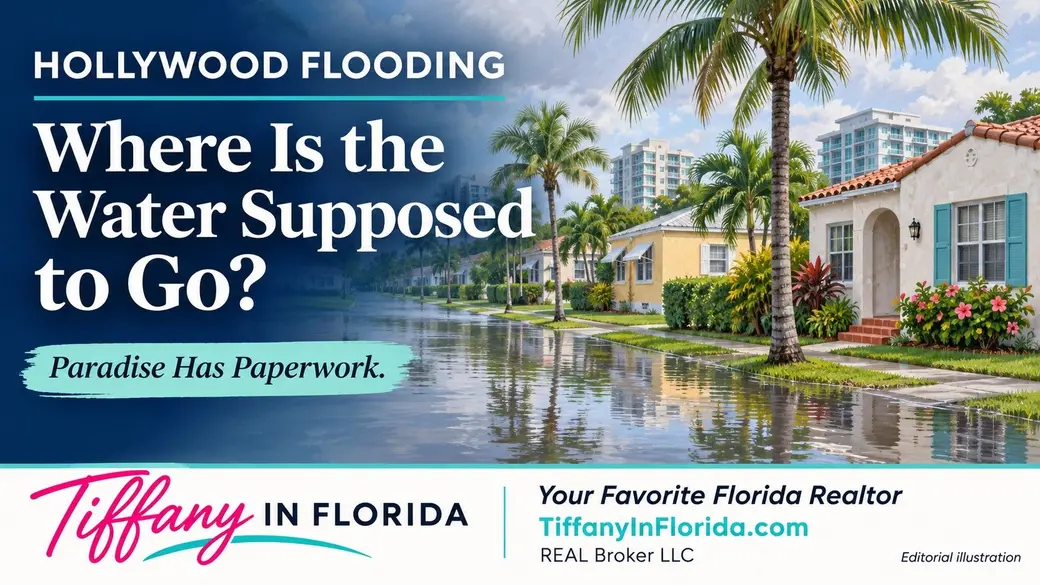
Hollywood Flooding: We Keep Building. Where Is the Water Supposed to Go?
By Tiffany Arthur | Your Favorite Florida Realtor
I just got off the phone with my Uncle. He has lived in the same home in Hollywood for over 70 years - and as both third and fourth-generation South Floridians, we understand that heavy rain comes with living here. But when streets and homes flood, I think we owe residents a better conversation about what happens to the water as we keep building.
Every new development should come with a straightforward question:
🌧️ Where will the water go—and what happens to the people already living nearby?
In Hollywood, there is a real basis for asking.
The city’s own stormwater website acknowledges that “rapid development over the past few decades has outpaced stormwater upgrades.” It also identifies aging infrastructure, low elevations, heavy rainfall, higher tides and rising sea levels as challenges.
That acknowledgment deserves attention. If growth has moved faster than the infrastructure needed to support it, residents are right to question how we plan for the next project.
💧 The Water Still Needs Somewhere to Go
Undeveloped land allows some rainfall to soak into the ground. Replace that land with rooftops, roads and parking lots, and more water runs across the surface, often faster. The U.S. Geological Survey identifies these changes as ways urban development can increase flooding.
This is what people often mean when they talk about the “redistribution of water.” Development can change how much water runs off, where it travels and where it collects.
Whether a particular project worsens flooding depends on its design and the surrounding drainage system. That is why examining what happens beyond the construction site matters.
🏘️ The Concerns Around DeLand Sound Familiar
In 2024, Central Florida Public Media reported complaints from residents around DeLand’s Victoria Trails, Sawyer’s Landing and nearby older properties.
Residents described persistent flooding and questioned whether elevated development had displaced water onto neighboring land. Environmental science professor Wendy Anderson raised similar concerns.
Those complaints were documented. The claim that development caused the flooding was contested.
The county’s March 2025 Taylor Road engineering study adds an important distinction. It documented extreme rainfall, saturated ground and a retention pond struggling to drain.
Its comparison of conditions before and after Victoria Trails was built found that the subdivision routed runoff into its own pond, including water that previously flowed toward the affected area. That finding complicates the argument that the development simply sent more surface runoff toward those neighbors.
Residents’ experiences deserve investigation. So do the engineering findings. Establishing responsibility requires more than observing that construction happened before flooding worsened.
📋 Hollywood Needs Answers Beyond Each Building Site
Hollywood’s stormwater plan includes drainage improvements, pumps and water-storage projects, with implementation envisioned over 20 to 30 years.
That is a substantial undertaking—and a long horizon for families dealing with recurring flooding.
My view is that residents deserve clear answers before additional development moves forward:
- Neighboring properties: How will the project change drainage around existing homes?
- Combined development: Does the analysis account for other approved and planned projects?
- Saturated ground: What happens when the soil and ponds are already full?
- Infrastructure timing: Which drainage improvements must be completed before occupancy?
- Accountability: Who maintains the system, and how will its performance be checked?
As a Realtor, I believe responsible growth includes protecting the people who already call a neighborhood home.
A new building’s drainage plan should explain what happens beyond its property line.
The question I want answered is simple: When the rain comes, where does the water go?
Tiffany Arthur
Your Favorite Florida Realtor
REAL Broker LLC
📞 561-372-8383
✉️ Tiffany@TiffanyInFlorida.com
🌴 TiffanyInFlorida.com
Paradise Has Paperwork.
Categories
- All Blogs (20)
- Boca Raton (1)
- Contracts (2)
- Deerfield Beach (1)
- Delray Beach (1)
- FloridaRealEstate (10)
- Homebuyers (6)
- Homebuying (5)
- Hometown Heroes (2)
- Housing (6)
- Investment (1)
- Local Insight (3)
- Market Update (3)
- Public Policy (1)
- RealEstate (8)
- Realtor (2)
- Snowbird (4)
- Vacation (1)
- Veterans (1)
Recent Posts




GET MORE INFORMATION